

Heating equipment specialist: a well-maintained heat pump can last up to 15 years
Air-to-water heat pumps, considered among the most efficient and environmentally friendly heating solutions, do not require much maintenance, but a few things should be kept in mind to enjoy their benefits for as long as possible. A heating equipment expert advises what every owner of a private house should do so that their heat pump serves for 10–15 years or more.
According to Mindaugas Beniušis, head of the Heating and Air Conditioning Department at Baltic Refrigeration Group, a correctly selected and properly installed air-to-water heat pump needs only minimal maintenance.
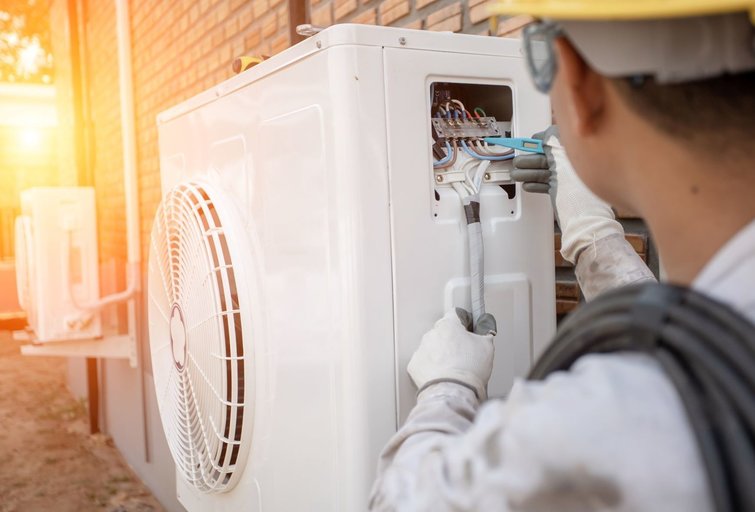
“For customers who have bought a heat pump, we recommend calling a service company once a year to clean the water filters in the system, check the pressure in the water and refrigerant systems, and top them up if necessary,” comments M. Beniušis.
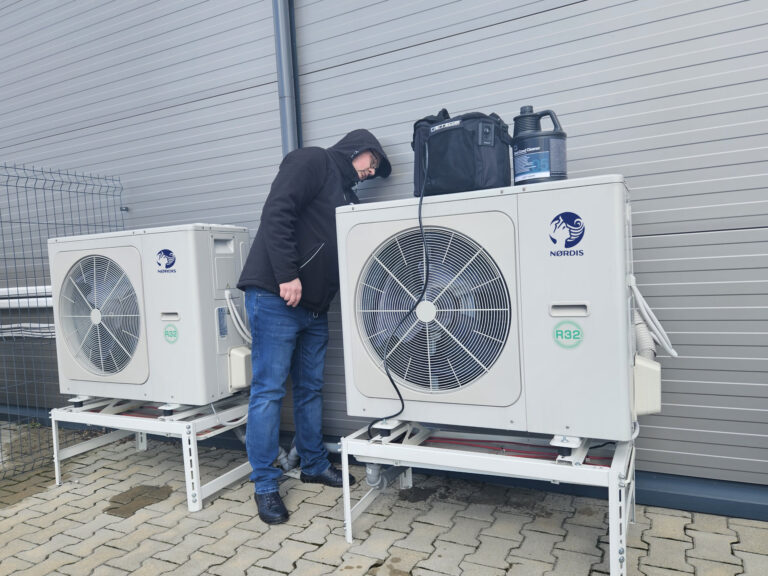
Equally important during the preventive check is to clean the heat exchanger of the heat pump’s outdoor unit of accumulated dirt.
“A very large flow of air circulates through the heat exchanger, so dust, tree leaves or debris can build up next to it and interfere with the operation of the heat pump. If the house stands in a dusty environment, we recommend cleaning the heat exchanger at least a couple of times a year,” advises the heating equipment specialist.
Water tanks must be cleaned
Air-to-water heat pumps require special attention to water quality. One of the greatest enemies of heat pumps is limescale.
“Water quality must meet the requirements set out in Lithuanian hygiene standards, but it sometimes happens that well water is very hard. Water with too much limescale damages the parts of the heat pump and reduces their efficiency and service life. An electric heating element coated with limescale emits less heat although it consumes the same amount of electricity, and a scaled heat exchanger lets water into the system less easily, so water softening filters are needed not only to ensure the quality of drinking water but also help the heat pump to work,” explains M. Beniušis.
The heating equipment specialist recommends cleaning and disinfecting hot water tanks once a year. Most manufacturers of hot water tanks have made special openings at the bottom of the tanks to make cleaning easier.
“Unfortunately, only a small share of users follow the manufacturers’ recommendations and clean and disinfect their hot water tanks. If dirty water is supplied to the drinking water system, dirt begins to accumulate at the bottom of the tanks over time, so at least once a year the water should be drained from the tanks and they should be cleaned properly,” says the Baltic Refrigeration Group representative.
For residents of private houses it is also very important to follow Legionella prevention – regularly keeping the hot water in the tank at a temperature of at least 60 degrees, at which these dangerous bacteria die. Legionella multiplies in water at temperatures from 20 to 45 degrees. According to the interviewee, there are cases where people risk their health in order to save electricity.
“Most often, heat pumps are programmed to automatically raise the hot water temperature to 66 degrees or more once a week, but this function can be switched off, which is not recommended. To reach this temperature, the heat pump needs to switch on an additional electric heating element – but people, in order to save electricity, switch it off or use it as rarely as possible, so the hot water does not reach the temperature required for Legionella prevention,” stresses M. Beniušis.
Improper use causes damage
The most common cause of heat pump failure is voltage surges and other power supply disturbances that damage the electronic control boards. However, improper use often harms the heating unit as well.
“Heat pumps are designed so that on very cold winter days an electric heating element helps them work, generating the missing amount of heat. However, to save money people disconnect the electric heating element or set it to switch on only when the outdoor temperature drops to almost -25°C. At such a low temperature it is very hard for the heat pump compressor to work, so its efficiency decreases over time, and a heat pump used in unfavorable conditions often has its service life shortened to 5 years,” says M. Beniušis.
Heat pump faults are revealed by unusual extraneous sounds and by reduced performance – for example, hot water taking longer to heat or less warmth in the house. Normally the control panel of the unit shows operating errors and their causes; if the errors recur after they have been eliminated, you should contact specialists.
Heat pump faults are most often fixed by replacing specific parts. Under the Lithuanian Civil Code, heat pumps, like other appliances, are covered by a 2-year warranty. For NORDIS heat pumps the manufacturer gives a 3-year warranty, and a 5-year warranty if an additional service contract is signed.
“A warranty with a service contract costs less than repairing a broken heat pump, especially as some of its parts are quite expensive. If you choose a service contract, the heat pump is checked every year by a heating equipment specialist. And with proper maintenance a heat pump can last 10–15 years or more,” comments M. Beniušis.