

Expert on Heat Pumps: Insulation Matters More Than House Size
Efficient home heating is one of the key questions faced by people building new houses or renovating existing ones. For a while, gas heating was the most popular choice, and many people used solid-fuel boilers. Today, however, attention is increasingly turning to heat pumps, which use environmental heat instead of fossil fuels to warm indoor spaces.
According to Mindaugas Beniušis, Head of the Heating and Air Conditioning Department at Baltic Refrigeration Group, a heat pump extracts energy (heat) from the air, water, or ground and, through a thermodynamic cycle, raises its temperature before transferring it to indoor units that heat living spaces or domestic hot water.
“Heat pumps are easy to install or integrate into existing heating and hot water systems. They reduce heating costs and do not emit harmful substances into the environment. The ‘fuel’ for these pumps is the heat stored in air, water, or soil—something the user doesn’t need to pay for like gas or firewood. This makes them both economical and environmentally friendly,” explains NØRDIS heat pump expert M. Beniušis.
Air as a Home Heating Source
There are several types of heat pumps on the market, but they all operate on the same principle—the main difference lies in where the heat is taken from and where it is delivered. Air-to-air heat pumps draw energy from outside air, then heat or cool it depending on the season, and blow it indoors through a fan. Air-to-water heat pumps also use outside air but transfer the generated heat into a water-based heating system, such as underfloor heating or radiators. Ground-to-water (geothermal) heat pumps function similarly to air-to-water systems, but they source energy from the ground.
According to the expert, the simplest and most affordable option is the air-to-air heat pump, though it is best suited for smaller homes or individual rooms and is not designed for domestic hot water production. The most efficient option is the geothermal system, which operates at a consistent rate year-round because ground temperature remains stable in both summer and winter. It also produces no noise, as it has no outdoor unit, but it is the most expensive choice.
Lithuanian homeowners most commonly choose air-to-water heat pumps, which M. Beniušis calls the optimal solution in terms of price-to-comfort ratio.
“These heat pumps are ideal for underfloor heating, which is now installed in nearly every newly built private house or townhouse. Moreover, their cost is much lower than geothermal systems, installation is simpler, and they heat both indoor spaces and domestic hot water almost as effectively,” he notes.
Heat Loss Matters More Than House Size
When choosing an air-to-water heat pump, one of the most important factors to consider is the Seasonal Coefficient of Performance (SCOP), which should be as high as possible. This ratio shows how much heat is produced compared to the electricity consumed, calculated using an approved methodology. For example, if a heat pump’s SCOP is 4, it means that for every 1 kW of electricity consumed, it produces 4 kW of heat.
“The pump’s capacity is also crucial. Many people mistakenly think it should be selected only based on house size. In reality, airtightness and heat loss are much more important. A small house may still be leaky, with many cold bridges or poorly sealed windows, which allow heat to escape quickly. In such cases, a heat pump chosen only by square footage will not work efficiently, and the homeowner will be dissatisfied with the unit—even though the device itself is fine, it just wasn’t the right fit for the home. That’s why, before purchasing a heat pump, it is essential to know the heat loss of the house, which must be calculated by qualified engineers,” emphasizes the expert.
He adds that problems usually don’t arise in homes with an energy class of A, A+, or A++, since these are built according to strict standards. However, homes with a B or lower energy class typically have higher heat losses and therefore require more powerful pumps.
“The type of heating system also matters—underfloor or radiator-based. With properly installed underfloor heating, an air-to-water heat pump doesn’t need to generate high-temperature water for heating, so it operates efficiently. The situation is different with radiators, which require higher water temperatures, making the pump less efficient,” says M. Beniušis.
Many homeowners also ask whether air-to-water heat pumps can provide sufficient heating in winter when outdoor temperatures drop well below freezing. According to the expert, heat pumps are equipped with electric heaters (up to 9 kW), which supplement heating when the compressor alone cannot generate enough energy.
Key Considerations
To install a heat pump, it is important to ensure that the electrical supply capacity is sufficient.
“In older houses or rural homesteads, the available power is often not enough. While it may be sufficient for an oven or stove, there might not be enough power reserve for a heat pump. In such cases, the solution is to upgrade the electrical connection, if possible and financially feasible,” Beniušis explains.
Heat pumps, like all electronics, are highly sensitive to voltage fluctuations, which can burn out the control boards and damage the system. Therefore, before purchasing a heat pump, it is crucial to know your home’s electrical capacity, and specialists must measure voltage stability on-site. If the capacity is insufficient or fluctuations are too high, installing a heat pump may not be possible.
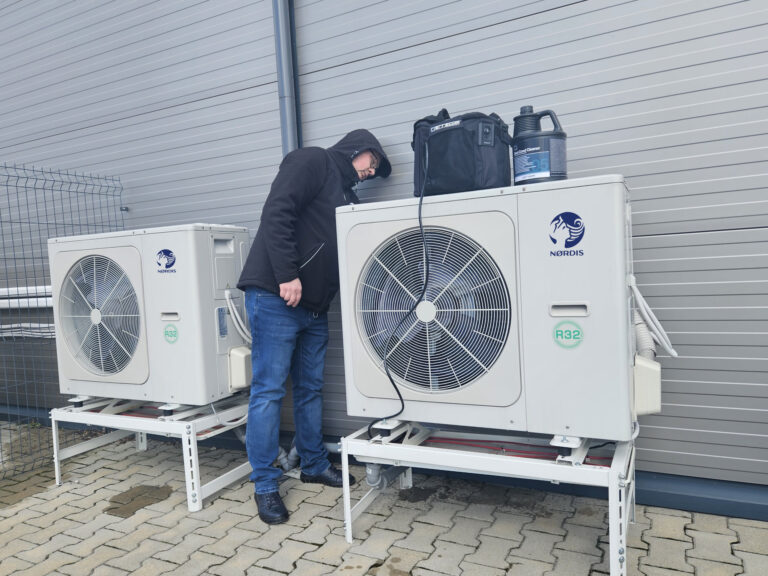
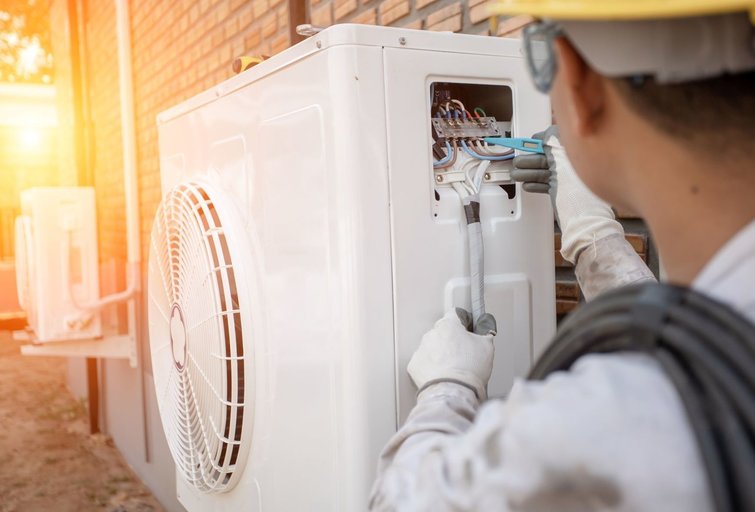
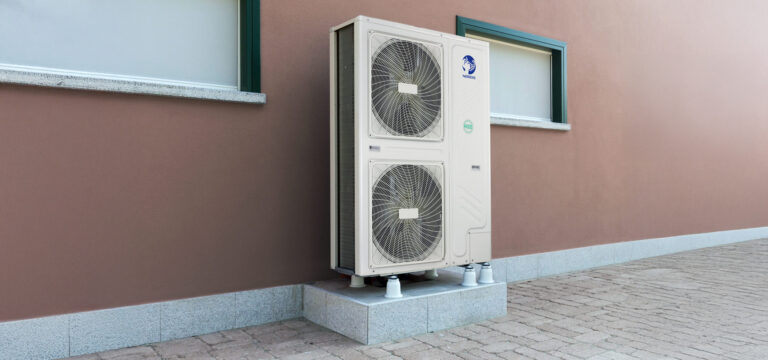
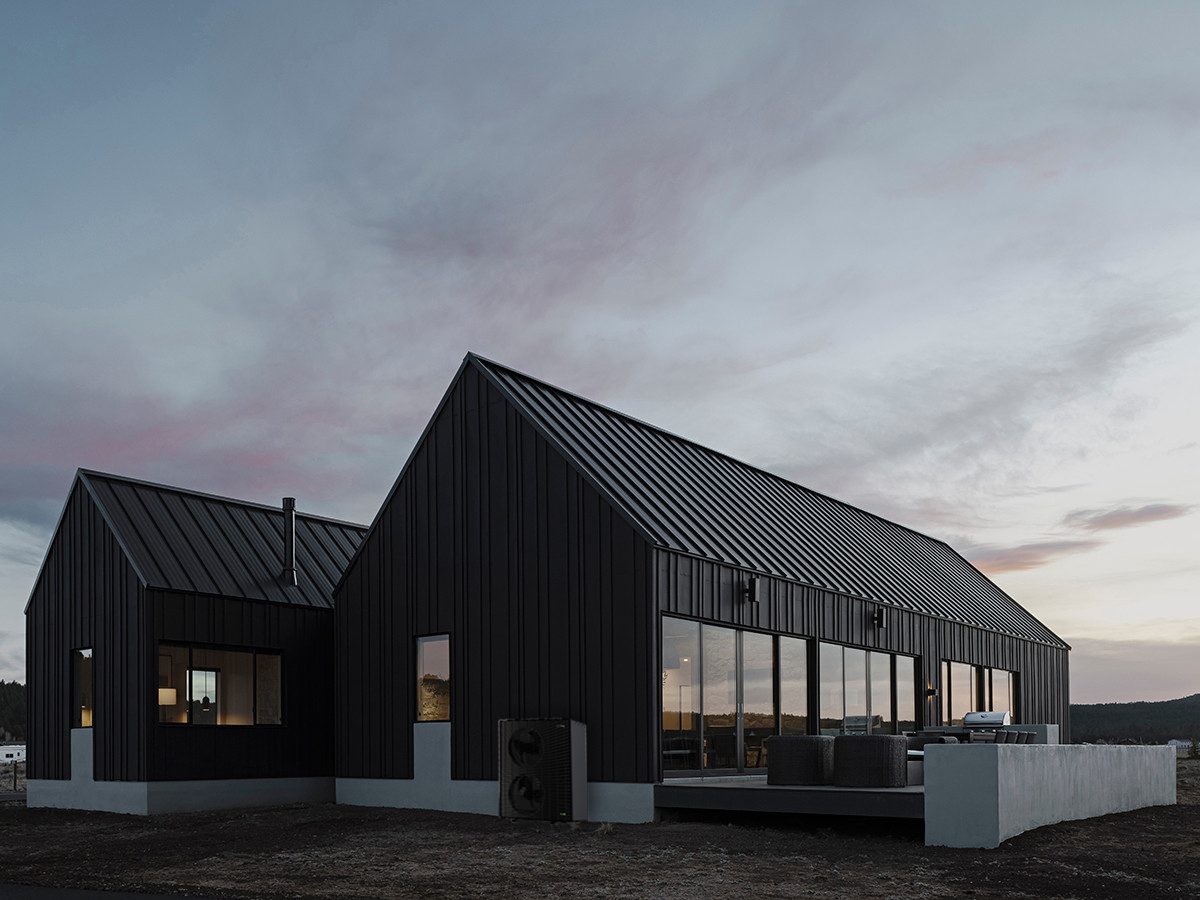
Air-to-water heat pumps typically consist of an outdoor and indoor unit. Ideally, installation requires only drilling a wall, though more complex interventions may be needed if refrigerant pipes must pass through several rooms or if the heating system is being renovated at the same time.
The indoor unit without an integrated hot water tank is usually placed in the boiler room, as it requires space alongside a separate tank. Units with an integrated tank can be installed anywhere, even in the kitchen, as long as the room is heated. The outdoor unit should be installed in a location protected from strong direct winds and sunlight. Wind may blow from the side but not directly into the device, as this could disrupt its operation, cause errors, and shut it down. Direct sunlight can also distort the unit’s temperature sensors, preventing it from starting. Therefore, the installer must carefully select the optimal location for each individual case.
“A heat pump that has already been installed doesn’t require much maintenance—only an annual check of filters and water pressure is recommended. A properly chosen and correctly installed air-to-water heat pump can last for many years. For owners of older houses, it becomes an even more economical investment thanks to government subsidies available for replacing fossil-fuel-based heating systems,” Beniušis points out.